


Introduction
PatientPoint is a US-based leading digital health company with a hiring function that reaches at least 50k candidates every year. They turned to Starred to better understand Candidate Experience and Employer Brand perception.
At the time, the company had gone through a merger and negative Glassdoor reviews were showing up directly in interviews. Candidates were arriving with concerns shaped by what they had read online before recruiters and hiring managers had a chance to tell PatientPoint's story themselves.
For the Talent Acquisition team, this highlighted a bigger issue. They were speaking with thousands of candidates every year, but they had very little visibility into how candidates actually experienced the hiring process and what impact it had on their TA KPIs.
What started as an Employer Brand initiative quickly evolved into something much bigger. Over time, Starred became an integrated part of how their TA team operates. Today, hiring feedback helps PatientPoint improve hiring operations, strengthen accountability, support leadership decision-making and ultimately make better decisions across the whole hiring journey, resulting in an increase of the overall cNPS by 56 points.
“Starred has opened up our eyes so much, we’re no longer making assumptions about what’s going on - we know exactly what is going on.” – Steven Amrhein, Manager, Employer Brand
PatientPoint’s hiring environment
PatientPoint hires across sales, engineering, customer support, client support and university programs while competing for highly specialized talent. Many of the roles require a very specific combination of skills, industry understanding and personality fit. In sales, for example, success depends on navigating a healthcare environment that looks very different from traditional B2B or SaaS sales.
“We want to attract the best people for what we do. And we acknowledge that this doesn’t mean just more candidates. We want to make sure that people hear our story and are a good fit for us. And what makes us different in the marketplace.” – Steven Amrhein, Manager, Employer Brand
At the same time, PatientPoint focuses on building a more scalable hiring function while trying to create consistency across the candidate journey.
To do that, they needed a clearer understanding of:
- What candidates were actually experiencing
- Where friction existed in the process
- How recruiters and hiring managers were being perceived
- Which improvements would have the biggest impact
What PatientPoint has done with Starred
First things first: Using candidate feedback to protect Employer Brand
PatientPoint’s first use case for Starred was closely tied to their Employer Brand. After the merger, negative Glassdoor reviews were creating real friction in hiring conversations with recruiters regularly getting questions about them during interviews. Candidates had already formed opinions about the company before speaking with anyone on the hiring team.
The TA team had no clear way of understanding whether those concerns reflected the experience candidates were currently having or perceptions that were no longer accurate.
By collecting structured feedback throughout the hiring journey, PatientPoint was able to identify recurring themes, improve communication and better understand where candidate expectations were not matching reality.
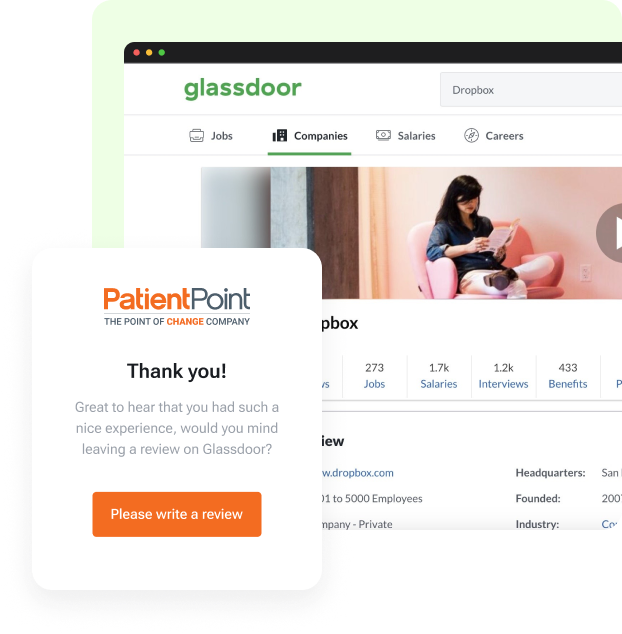
The team also incorporated Starred into its broader Employer Brand strategy, encouraging satisfied candidates to share their experiences publicly through the Thank You page redirect.
Within about a year, the conversations around Glassdoor disappeared from interviews and PatientPoint saw a 34.4% increase in their Glassdoor score since, improving the rating from 3.2 to 4.3.
“Within a year, we saw our ratings go up and the questions and citations completely went away. It wasn’t a part of our story anymore.” – Steven Amrhein, Manager, Employer Brand
This internal success story was especially valuable to top management and business stakeholders where Glassdoor was one of the measures of success they specifically paid attention to.
Employer Brand outcome:
- Glassdoor concerns stopped appearing in interviews
- Positive candidate experiences were redirected to Glassdoor
- Employer Brand became easier to manage with data
- Reputation became a measurable part of the hiring strategy
Hiring operations improvement
As more feedback started coming in, PatientPoint began seeing patterns that extended beyond Employer Brand. Data became a source of operational insight: a way to understand recruiter performance and hiring manager consistency that can be reported to leadership.
Recruiter accountability
PatientPoint integrated candidate feedback directly into recruiter performance conversations, where recruiters are evaluated on candidate sentiment, experience scores and how their results compare to team benchmarks. These scores have become a part of quarterly performance discussions and are directly tied to recruiter bonus goals.
For recruiters the feedback helped create accountability, identify coaching opportunities and help the team understand what candidates were experiencing across different recruiter interactions.
Hiring manager enablement
Another aspect of how PatientPoint uses candidate feedback day-to-day is to improve hiring manager consistency. Initially, Starred data showed that recruiter scores were strong, but the experience became less predictable once candidates moved from recruiter conversations into hiring manager interviews.
With Starred, PatientPoint gained a stronger pulse on hiring manager performance and used those insights to build a more structured process. The team introduced quarterly hiring manager training, standardized interview questions and a more consistent interview approach. Recruiters now work with hiring managers before interviews to align on responsibilities, evaluation criteria and what each interviewer should focus on. As proof that all of the initiatives are working they saw an improvement in the Hiring Manager Satisfaction Score by 43% since implementing Starred 3 years ago.
Individual candidate scorecards are required to be filled within 24 hours after interviews which resulted in a quicker and much more consistent hiring process. PatientPoint’s time-to-fill was reduced by 21.8% (12 days) with an average time-in-stage of just 3 days.
“It’s like a well-oiled machine now. Our recruiters work a lot more in tandem with the hiring managers. And we move candidates through the journey a lot quicker and have actionable feedback data to give to the candidates, no matter if we proceed with their application or not.” – Steven Amrhein, Manager, Employer Brand
Outcomes: Process improvement & hiring quality
Improved candidate assessment touchpoint
One of the strongest examples of feedback-driven process improvement came from PatientPoint’s sales assessment.
Sales candidates were giving consistently negative feedback about the assessment stage. Many were not used to completing an assessment as part of the hiring process and were unclear about how it impacted their outcome.
At first, the team discussed whether the assessment should be removed completely. But because the assessment was closely tied to success in the role, PatientPoint used candidate feedback to better understand what was actually causing the frustration.
One of the biggest topics that came up was communication. Candidates did not always understand what the assessment was designed to measure, why it mattered or how it connected to success at PatientPoint.
In response, recruiters now spend more time setting expectations before the assessment. PatientPoint also created stronger messaging, including email communication and recruiter talking points for phone screens.
By clarifying that upfront, recruiters could set better expectations and encourage candidates to answer honestly rather than trying to guess what the company wanted to hear.
“We wanted our recruiters to be able to articulate that the assessment is not an assessment of your selling ability and it's not a personality assessment, but it's how you do both of those things in our selling ecosystem.” – Steven Amrhein, Manager, Employer Brand
Leadership engagement
Starred also became part of how PatientPoint communicates hiring performance to leadership.
By using quarterly scorecards for executives that include NPS trends, hired vs. rejected candidate sentiment, response rates, recurring themes and flagged comments, PatientPoint was able to showcase the leadership data-backed proof of how candidates experience the hiring process. This resulted in a level of visibility that hadn't existed before and moved discussions beyond opinion and intuition.
“Starred gives us a lot of details and a lot of data on every point a candidate has in the journey in PatientPoint, and on the people they interact with. It helps us make business decisions based on data instead of intuition.” – Steven Amrhein, Manager, Employer Brand
This leadership engagement also shows up in how PatientPoint handles negative feedback.
When a candidate submits a poor rating, it gets flagged by Starred and sent to PatientPoint’s VP of Talent Acquisition. They review the feedback, reach out to the people involved in the process to understand PatientPoint’s side of the story and then personally responds to each candidate who has had a negative experience.
This creates an immediate feedback loop and reinforces that Candidate Experience is shared responsibility between the team and leadership.
“We like getting notifications about people who are ranking us poorly and they go directly to the inbox of our VP of Talent Acquisition. And he responds to every single one. I think that has created a really personalized touch and shows that we do take to heart how our candidates are being treated throughout the process.” – Steven Amrhein, Manager, Employer Brand
The same applies when a hiring manager is consistently receiving lower scores. The VP of Talent Acquisition investigates what is happening and identifies how the team can improve the experience.
Conclusion: Results and impact
PatientPoint started with a simple goal: to understand what candidates were experiencing.
But by choosing Starred, they got much more. They gained a way to improve hiring decisions, strengthen accountability and make hiring more data-driven.
With Starred, they have been able to:
- Protect and improve employer brand perception
- Create stronger internal team accountability
- Standardize interview processes
- Improve assessment communication
- Act quickly on negative candidate feedback
- Reduce time-to-fill through structured hiring workflows
- Make hiring decisions based on data instead of assumptions
Do you also want to replace assumptions with actionable hiring insights? See how Starred can help you collect structured insights from candidates, hiring managers and recruiters throughout the hiring process and flag issues before they escalate.